
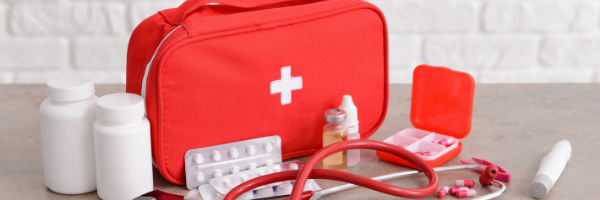
An IFAK, short for Individual First Aid Kit, is not your grandmother’s Band-Aid tin stuffed with aspirin packets and cartoon adhesive strips. It is a purpose-built emergency trauma kit designed to keep a human being alive during the critical minutes after a serious injury.
The modern IFAK emerged largely from military medicine, especially lessons learned during the wars in Iraq and Afghanistan. Combat medics and trauma surgeons discovered something both sobering and hopeful: many battlefield deaths were preventable if severe bleeding and airway problems were treated quickly enough. In response, trauma medicine evolved dramatically, and the compact, rapidly deployable IFAK became standard equipment for soldiers.
Eventually the idea migrated into civilian life. Today, you’ll find IFAKs carried by:
- law enforcement officers
- hunters
- off-road travelers
- hikers
- ranchers
- shooting instructors
- overlanders
- wildfire crews
- prepared civilians
Especially in rural or remote areas, where ambulance response may be measured not in minutes, but in geologic epochs.
An IFAK is fundamentally different from a general first aid kit.
A traditional first aid kit handles:
- headaches
- blisters
- minor cuts
- allergies
- tummy trouble
An IFAK addresses:
- catastrophic bleeding
- penetrating trauma
- severe lacerations
- chest wounds
- airway emergencies
It exists for the moments when things have gone very wrong, very quickly.
IFAK Contents
At the heart of most modern IFAKs is the tourniquet. In many ways, the tourniquet has become the defining symbol of modern trauma medicine. For decades, people feared tourniquets because of myths about inevitable amputations. Modern evidence completely overturned much of that thinking. Properly used tourniquets save lives, often dramatically.
A quality tourniquet such as a CAT or SOF-T Wide can stop catastrophic extremity bleeding in seconds. In remote country, that can be the difference between an ugly story and a tragedy.
Closely related is hemostatic gauze – specialized gauze impregnated with agents that accelerate clotting. Products such as QuikClot Combat Gauze are designed for wound packing in areas where a tourniquet cannot be applied, such as the groin, shoulder, or deep lacerations.
Pressure dressings come next. Israeli bandages and similar trauma dressings combine absorbent material with mechanical pressure to help control bleeding after wound packing or direct pressure.
Then there are chest seals, one of the more intimidating-looking items in an IFAK. These adhesive occlusive dressings are used for penetrating chest trauma. Their purpose is to reduce the risk of tension pneumothorax, a condition where air trapped inside the chest cavity progressively collapses a lung and begins shifting the heart and mediastinum. In plain English: a very bad day.
Most IFAKs may also contain:
- nitrile gloves
- trauma shears
- tape
- markers
- emergency blankets
Some contain airway adjuncts such as nasopharyngeal airways. More advanced kits may include decompression needles or medications, though those require significant training and judgment.
And this is where an important point emerges, the gear itself is not the magic. Training matters far more.
A beautifully assembled IFAK does little good if the owner freezes during an emergency or has never practiced applying a tourniquet. Fortunately, meaningful training is now widely available. Programs such as Stop the Bleed have done an extraordinary job teaching ordinary people the basics of trauma response.
Even a few hours of competent instruction can dramatically increase confidence and effectiveness.
One of the biggest mistakes people make is buying junk equipment. The internet is flooded with counterfeit tourniquets and “tactical” kits filled with low-quality gadgets and nearly useless accessories. A proper IFAK is surprisingly simple. A handful of high-quality items matters far more than a backpack full of gimmicks.
Another mistake is accessibility. In an actual emergency, seconds matter. If your IFAK requires unpacking coolers, sleeping bags, and recovery boards before you can reach it, it is poorly staged. Many experienced travelers mount trauma kits:
- on a belt
- on vehicle seatbacks
- inside door panels
- on range bags
- attached to backpacks
- near roll bars
- beside fire extinguishers
Within arm’s reach is ideal.
For people who travel remote backroads such as Utah canyon country, Colorado forest roads, desert two-tracks, or isolated ranchland an IFAK begins to make increasing sense. Modern vehicles are extraordinarily capable of taking us far from immediate help. That freedom comes with responsibility.
In context, the IFAK becomes less about paranoia and more about competence. Most people who carry one hope they never use it. That is precisely the point.
Because if the moment ever comes when someone is bleeding badly beside a remote trail, on a range, along a highway, or in the middle of nowhere beneath an enormous western sky, the small pouch labeled “IFAK” may suddenly become the most important object in sight.
My Personal IFAK
MARCH
Trauma medicine has evolved dramatically over the past two decades, particularly through lessons learned in military and emergency response settings where seconds often determine survival. Out of that experience emerged a remarkably practical framework known as MARCH — an acronym standing for Massive Hemorrhage, Airway, Respiration, Circulation, and Hypothermia/Head Injury.
The system helps rescuers prioritize the most immediate life-threatening problems in a structured, logical sequence. Rather than becoming overwhelmed by chaos, blood, panic, or the sheer emotional weight of an emergency,
MARCH provides a clear roadmap for identifying and treating the injuries most likely to cause preventable death. Whether in combat, on a remote trail, at a shooting range, after a vehicle accident, or during a backcountry emergency, understanding the principles of MARCH can help transform confusion into focused action when it matters most.
Below is my list for MARCH as well as a few other categories to help round out a complete emergency kit.
Massive Hemorrhage
- CAT
- Quickclot
- Compressed gauze
- Kerlex / Coban / Israeli gauze / Emergency Trauma Dressing (ETD)
- Duct tape
- iTClamp
Airway
- NP airway
- King airway
- I-Gel airway
- Cric kit / Cric-Key / Control Cric kit
- Tracheotomy kit
- Laryngoscope
- Bag mask
Respirations
- CPR face mask
- Chest seal
- Decompression needle
- Pneumothorax kit
Circulation
- IV fluids
Head Injury / Hypothermia
- Survival blanket
- Survival wrap
- Hand warmers
Orthopedic
- SAM splint
- Triangular bandage
- Ankle brace
- ACE / Coban
Wound Care
- Burn dressings, Burntec
- Bandages, variety
- Steri strips
- Super glue, Dermabond
- Irrigation supplies
- Sutures
- Surgical, needle drivers, tweezers
Misc
- Trauma scissors
- Sharpie
- Gloves
- Flashlight
- Rescue tool – web cutter, glass breaker
For more information on putting together a first aid kit, see my article on Adventure Medical Kits.
Author
Scott Rollins, MD, is Board Certified with the American Board of Family Practice and the American Board of Anti-Aging and Regenerative Medicine. He specializes in bioidentical hormone replacement for men and women, thyroid and adrenal disorders, fibromyalgia and other complex medical conditions. He is founder and medical director of the Integrative Medicine Center of Western Colorado (www.imcwc.com) and Bellezza Laser Aesthetics (www.bellezzalaser.com). Call (970) 245-6911 for an appointment or more information.
