
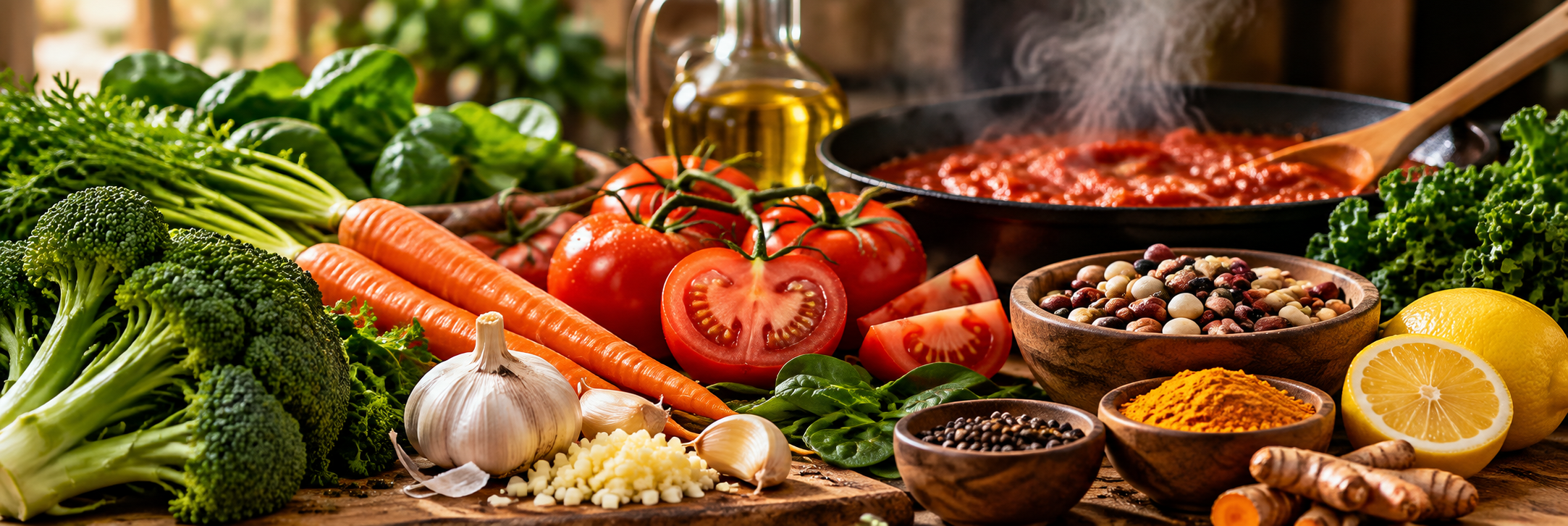
We tend to think of nutrition as inventory. A carrot contains this much beta-carotene. A tomato contains this much lycopene. Spinach has iron. Garlic has allicin. End of story.
Except food isn’t a warehouse, and the human digestive tract isn’t a forklift.
A nutrient can be sitting right there on your dinner plate and still be remarkably difficult for your body to obtain. Plants, after all, did not evolve fruits, roots, leaves, and seeds for the purpose of making us healthy. Their nutrients are tucked inside cells, bound to proteins, packaged with fiber, protected by chemical compounds, and occasionally locked behind walls our digestive enzymes aren’t particularly good at opening.
Fortunately, humans discovered some rather clever ways of picking those locks.
We cook. We chop. We crush. We soak. We ferment. And sometimes we simply add olive oil.
The Tomato Paradox
Raw tomatoes are wonderfully nutritious, but something interesting happens when you cook them. I know for sure the taste changes, as I hate raw tomatoes, but love a good slow cooked marinara!
Tomatoes are rich in lycopene, the red carotenoid associated with cardiovascular health and studied for possible protective effects against several cancers. Much of that lycopene is trapped within the plant’s cellular structure.
Heat begins breaking those structures apart. Cooking tomatoes changes the configuration of some lycopene molecules into forms that appear to be more readily absorbed by humans. Studies comparing raw tomatoes with processed tomato products have demonstrated greater lycopene bioavailability after cooking and processing.
Then there is another trick. Add olive oil.
Lycopene is fat-soluble. Eating tomatoes with a little fat can substantially improve its absorption. Thus, one of the most nutritionally intelligent foods on Earth may have been invented centuries before anyone knew what a carotenoid was, tomato sauce cooked with olive oil.
Wy wife’s Italian Grandmother wins again.
Carrots Like a Little Heat Too
Carrots provide another good example. Their brilliant orange color comes largely from carotenoids, particularly beta-carotene, which the body can convert into vitamin A. But beta-carotene is stored within tough plant cells. Cooking softens those structures and makes the carotenoids more accessible to digestion.
Pureeing can take things another step. A cooked, pureed carrot may therefore deliver considerably more accessible beta-carotene than gnawing on the same carrot raw.
And once again, fat matters. A little butter or olive oil helps the intestine absorb these fat-soluble carotenoids. The old-fashioned practice of putting butter on cooked vegetables wasn’t necessarily nutritional vandalism.
Garlic Needs to Be Injured
Garlic is stranger still. An intact clove contains very little allicin, the sulfur compound responsible for many of garlic’s characteristic biological effects.
Instead, garlic keeps two ingredients separated inside its cells, alliin and the enzyme alliinase. Crush the garlic and the cellular compartments rupture. Alliinase encounters alliin and begins producing allicin.
In other words, garlic manufactures one of its most interesting compounds after you attack it with a knife.
There is another useful trick. Alliinase is sensitive to heat. If garlic is crushed and immediately tossed into a very hot pan, some of the enzyme can be destroyed before much allicin forms. Crush or chop the garlic first and let it sit for roughly 10 minutes before cooking, and the enzyme has time to do its work.
Garlic apparently appreciates a brief period to contemplate what you’ve done to it.
Broccoli Has the Same Problem
Broccoli and other cruciferous vegetables, including cauliflower, cabbage, kale, Brussels sprouts, and mustard greens, contain compounds called glucosinolates.
When plant tissue is damaged, an enzyme called myrosinase helps convert these compounds into biologically active molecules, including sulforaphane.
Unfortunately, prolonged high-temperature cooking can deactivate myrosinase. This creates an interesting culinary puzzle.
Chopping broccoli before cooking gives myrosinase time to work. Light steaming can preserve much of the chemistry while making the vegetable more digestible.
There is also a clever rescue strategy for thoroughly cooked broccoli. Add a small amount of mustard powder afterward. Mustard contains active myrosinase that can help convert the remaining glucosinolates.
Broccoli with mustard isn’t merely seasoning, it’s chemistry assistance.
Spinach Is Complicated
Cooking isn’t always about releasing nutrients from plant cells. Sometimes it reduces compounds that interfere with nutrient availability.
Spinach contains oxalates, which can bind minerals such as calcium and reduce their absorption. Boiling spinach can substantially reduce soluble oxalate because some of it migrates into the cooking water. But there is a tradeoff.
Water-soluble nutrients such as vitamin C and folate can also be lost during prolonged boiling.
This is why there is rarely one universally “best” way to prepare a vegetable. Raw spinach preserves some nutrients particularly well. Cooked spinach makes others more available and reduces oxalate.
The sensible answer isn’t to join Team Raw or Team Cooked. Eat spinach both ways.
Beans Need Preparation
Beans provide an even more dramatic example of food processing improving nutrition. Raw legumes contain compounds such as lectins and phytates. Phytates can bind minerals including iron, zinc, calcium, and magnesium, reducing their absorption. Certain lectins can bind to the lining of the digestive tract, interfering with normal intestinal function and nutrient absorption, and in large amounts can cause significant gastrointestinal distress. Fortunately, soaking and especially thorough cooking dramatically reduce lectin activity while also reducing phytate and making beans easier to digest.
Traditional cultures developed several solutions long before anyone knew what phytic acid was. They soaked beans. They sprouted grains. They cooked legumes thoroughly. These processes can reduce various anti-nutritional compounds while making starches and proteins easier to digest.
Turmeric Needs Friends
Curcumin, one of the most studied compounds in turmeric, presents a different problem. You can swallow plenty of curcumin and absorb surprisingly little of it. One famous culinary combination helps.
Black pepper contains piperine, which can markedly increase circulating concentrations of curcumin by altering its metabolism and disposition. Curcumin is also fat-soluble, which makes consuming turmeric as part of a meal containing fat sensible. Thus turmeric, pepper, and fat make a biochemical partnership considerably more interesting than turmeric alone.
Again, traditional cuisine seems to have arrived at the combination without needing a randomized controlled trial.
Iron Needs a Wingman
Sometimes the important interaction isn’t cooking at all.
Plant foods contain non-heme iron, which is considerably less readily absorbed than heme iron from animal foods. Vitamin C can dramatically improve non-heme iron absorption by maintaining iron in a more absorbable chemical form and helping overcome some dietary inhibitors.
Beans with tomatoes. Spinach with lemon. Lentils with peppers. These aren’t merely flavor combinations. They change what your body can extract from the meal.
The opposite can also occur. Tea and coffee contain polyphenols that can substantially decrease non-heme iron absorption when consumed with a meal.
So what accompanies a food can matter almost as much as the food itself.
Fermentation Lets Microbes Do Some of the Work
Fermentation is essentially pre-digestion by microorganisms. Bacteria and yeast begin breaking down components of food before we eat it, sometimes making nutrients easier to obtain.
Fermentation can reduce phytate, improving the availability of minerals such as iron and zinc. It can also improve digestibility; yogurt bacteria, for example, consume some lactose and provide lactase, which helps explain why some people tolerate yogurt better than milk.
Foods such as yogurt, kefir, sauerkraut, kimchi, miso, tempeh, and sourdough are all products of this ancient nutritional technology. Some unpasteurized fermented foods also provide living microorganisms that can interact with our gut microbiome.
Our ancestors didn’t know anything about microbes or enzymes. They simply discovered that if you let the little guys work on dinner first, you get more out of it.
Sometimes Raw Really Is Better
None of this means we should cook everything into submission.
Heat can destroy or reduce certain nutrients, particularly vitamin C and some B vitamins. Long cooking in large amounts of water can allow water-soluble vitamins and minerals to migrate into the cooking liquid, which is fine if you’re making soup and drink the broth, but less useful if you pour it down the sink.
The point isn’t that cooked food is better than raw food. The point is that food preparation changes food.
A raw tomato and tomato sauce are not nutritionally identical. Neither are raw and cooked carrots, freshly crushed and uncrushed garlic, or raw and cooked beans.
Each preparation reveals something different.
We Have Been Processing Food Forever
The word processed has acquired an unfortunate reputation. But chopping an onion is processing. Grinding wheat is processing. Making yogurt is processing. Cooking beans is processing.
The important distinction isn’t between processed and unprocessed food. It’s between useful processing and destructive processing.
Humans have spent thousands of years learning how to make food safer, more digestible, more delicious, and in many cases, more nutritious. Fire, fermentation, grinding, soaking, crushing, and combining foods may be among our oldest nutritional technologies.
That is the larger lesson. We spend enormous amounts of time asking, “What should I eat?” We should occasionally the question, “How should I eat it?”
The nutrients are already sitting on the plate, we just need us to unlock the door.
Author
Scott Rollins, MD, is Board Certified with the American Board of Family Practice and the American Board of Anti-Aging and Regenerative Medicine. He specializes in bioidentical hormone replacement for men and women, thyroid and adrenal disorders, fibromyalgia and other complex medical conditions. He is founder and medical director of the Integrative Medicine Center of Western Colorado (www.imcwc.com) and Bellezza Laser Aesthetics (www.bellezzalaser.com). Call (970) 245-6911 for an appointment or more information.
