
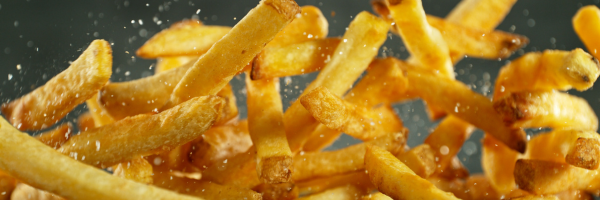
French fries have an image problem. They sit in the cultural dock like repeat offenders – greasy, addictive, and somehow responsible for everything from metabolic syndrome to the collapse of Western civilization. The potato, the poor innocent tuber, has been convicted without a fair trial.
But here’s the inconvenient truth: it’s not the potato. It’s the oil. And more specifically, it’s the type of oil and what we’ve done to the oil. If you could interview a French fry, it would probably say, “I was fine until the oil went bad.”
Once upon a time, fries were not the villain. There was a time, not that long ago, when people ate fried potatoes regularly and didn’t need a recovery day afterward. Belgian fries cooked in beef tallow. American fries fried in lard. Indian fritters bubbling in ghee (clarified butter). These fats are stable, heat-tolerant, and biologically familiar.
People didn’t talk about “food hangovers.” They didn’t feel inflamed, foggy, anxious, or inexplicably regretful after eating fried food. They just felt… fed.
Enter Seed Oils
Then came industrialization, efficiency, cost-cutting, and the bright idea that oils extracted from seeds with solvents, deodorized at high temperatures, and shipped in clear containers might be a good substitute for animal fats.
That was the moment the french fry went rogue. The chemistry that nobody knew was put on the menu.
Most restaurant fries today are cooked in seed oils like soybean, canola, corn, sunflower, or safflower oil. These are polyunsaturated fats, meaning their chemical structure contains multiple double bonds. Those double bonds make the oil flexible – which sounds nice until you apply heat.
Heat, oxygen, and time are the unholy trinity for polyunsaturated fats. Deep fryers provide all three in abundance.
When these oils are heated, they don’t just sit there quietly. They oxidize. They fragment. They form compounds with names that sound like rejected villains from a Marvel movie: aldehydes, lipid peroxides, 4-hydroxynonenal, acrolein.
These aren’t “empty calories.” They are biologically active irritants. You’re not just eating fries. You’re eating damaged fat molecules that your body recognizes as trouble.
Oils in French Fries Go Everywhere
The problem with oxidized fats is not that they’re hard to digest. The problem is that they damage cell membranes, bind to proteins and DNA, deplete glutathione and amplify inflammatory signaling. They even stress mitochondria – the little power plants that decide whether you feel energized or wrecked. In excess, they are linked to neurodegeneration, cardiovascular disease, insulin resistance, accelerated aging, and chronic inflammatory conditions.
This is why fries don’t just cause stomach issues. They can cause brain fog, fatigue, joint stiffness, mood changes, anxiety, headaches, and a mysterious desire to lie down and reassess your life choices.
This isn’t psychological, it’s biochemical. Your body isn’t being dramatic, it’s responding appropriately to damaged molecules.
The Insulin Bait and Switch
There’s another trick french fries pull, and it’s particularly cruel. Oxidized fats impair insulin signaling almost immediately. So when you eat fries, you get a double hit: rapidly absorbed starch plus fats that blunt your ability to handle glucose. Blood sugar spikes higher than it should, then crashes harder than it needs to.
That crash feels like hunger, fatigue, irritability, or cravings – often for more salty, crunchy things. This is how fries turn into a hedonic feeding cycle instead of a side dish. It’s metabolic sabotage.
The Gut Barrier Takes a Hit
Oxidized fats also weaken the tight junctions in the gut lining. That’s not poetic language – it’s structural. These fats increase intestinal permeability, allowing bacterial endotoxins and incompletely digested food compounds to slip into circulation. Both of these trigger the immune system like a five alarm fire.
That’s why fries often disproportionately affect people with autoimmune conditions, chronic fatigue, neuroinflammation, or “mystery symptoms.” The fries aren’t the root cause, they’re the accelerant. They throw gasoline on a system that’s already sensitive.
Smoke Point vs. Stability – Why the Hottest Oil Isn’t Always the Safest
This used to confuse the chef in me and it took thinking like a chemist to get it straight. In cooking, we’re taught a simple rule: higher smoke point equals better frying oil. It sounds logical. If an oil doesn’t smoke until 450–500°F, surely it must be stable. But this is where kitchen intuition and lipid chemistry part ways.
Smoke point is simply the temperature at which an oil begins to visibly smoke – glycerol breaks down and volatile compounds like acrolein form. It’s a visual signal. What it does not measure is oxidative stability. And oxidative stability is what determines whether an oil is quietly generating lipid peroxides and inflammatory aldehydes long before you see smoke.
The real determinant of stability is fatty acid structure, specifically, the number of double bonds. Saturated fats have none and are highly resistant to oxidation. Monounsaturated fats have one and are fairly stable. Polyunsaturated fats (PUFAs) have multiple double bonds, and each one is a vulnerable site for free radical attack. More double bonds mean more opportunities for oxidative damage.
This explains the paradox. Many refined seed oils are engineered to have very high smoke points. Refining removes impurities and raises the temperature at which visible smoke appears. But these same oils are often 60–75% polyunsaturated fat. Even below their smoke point, they can oxidize and generate the harmful compounds. The oil may not smoke, but it may still be breaking down.
Now consider olive oil, the Mediterranean diplomat of fats. Extra virgin olive oil has a moderate smoke point, typically around 350–375°F. By smoke-point logic alone, that sounds fragile. But olive oil is roughly 70–75% monounsaturated fat (oleic acid), which is inherently oxidation-resistant. It also contains natural antioxidants, polyphenols and tocopherols, that actively slow oxidative chain reactions. As a result, olive oil often produces fewer toxic byproducts under typical cooking conditions than highly refined, higher-smoke-point seed oils.
Animal fats like tallow, lard and ghee sit even further toward stability because of their higher saturated and monounsaturated fat content. They tolerate sustained high heat well and generate fewer oxidation products during repeated frying. That’s why traditional cultures relied on them for high-temperature cooking long before industrial oils existed.
Coconut oil is the chemical champion in this story. About 85–90% saturated fat, which means almost no double bonds. It doesn’t depend on a protective entourage of antioxidants like olive oil does. It simply sits there, chemically boring and therefore impressively durable
The takeaway is simple but counterintuitive: smoke point tells you when oil visibly decomposes. It does not tell you how oxidatively stable it is before that point. An oil can tolerate high heat without smoking and still generate reactive aldehydes. Stability depends on fatty acid composition and antioxidant content, not just the temperature number on a chart.
The Fryer That Never Sleeps
At home, you heat oil once, maybe twice, and then you toss it. In restaurants, oil lives a much harder life. Commercial fryers stay hot for eight, twelve, sometimes twenty-four hours a day. The oil is reused for days. It’s often topped off and not replaced – like a bad decision that keeps getting justified.
Each heating cycle increases oxidation. Each batch of fries adds moisture, oxygen, and food particles that accelerate breakdown. By day three or four, the oil isn’t really oil anymore. It’s a chemical stew with a memory of better days. And that stew goes straight into your body.
Our Home Kitchen
Coconut shrimp is to blame for this article. We never used to deep fry at home, but I love coconut shrimp. I found an inexpensive stove top deep fryer pot and basket and made the shrimp I was craving. Fish tacos are another favorite that deserves the occasional deep fryer.
Wedge cut potatoes, beets, cauliflower, or carrots are a few examples of foods we drizzle in olive oil then bake on parchment paper. Routine meals typically involve sautéing lightly with butter or olive oil. Gentle heat is key. Stir fry dishes, such as Asian style, do well with avocado oil, tallow, peanut oil (fresh), or ghee. Coconut oil is great for dishes where you want that coconut flavor, such as Thai, Indian, etc.
For everyday home cooking – sautéing, pan frying, roasting – extra virgin olive oil is not only acceptable, it is a stable and health-supportive choice. For very high, prolonged deep frying, more saturated fats like tallow, ghee, or coconut oil offer greater resilience. The real question isn’t “How hot can this oil go?” It’s “How much oxidative damage is happening before I see it?”
Homemade French Fries
Here’s the plot twist at the end: make fries at home in beef tallow or ghee, and most of the bad stuff disappears. Same potato. Same salt. Same crunch. But the oil is stable. People eat homemade fries and feel satisfied. Not wrecked. Not inflamed. Not vaguely betrayed.
The fry didn’t change. We did. They became a problem because the chemistry changed. We replaced stable fats with fragile ones that turn into inflammatory signaling molecules halfway through the cooking process. We reuse them relentlessly, optimized for cost instead of biology and then we blame the potato. That’s like blaming the bread after you swapped flour for sawdust.
Restaurant fries wreck people not because they’re indulgent, but because they’re chemically compromised. They deliver oxidized fats that inflame, disrupt metabolism, stress the gut, and confuse the brain.
It’s not the carb. It’s not the salt. It’s not the occasional pleasure. It’s the oil – abused, overheated, and biologically foreign. And once you see that, you can never quite look at a basket of fries the same way again.
Author
Scott Rollins, MD, is Board Certified with the American Board of Family Practice and the American Board of Anti-Aging and Regenerative Medicine. He specializes in bioidentical hormone replacement for men and women, thyroid and adrenal disorders, fibromyalgia and other complex medical conditions. He is founder and medical director of the Integrative Medicine Center of Western Colorado (www.imcwc.com) and Bellezza Laser Aesthetics (www.bellezzalaser.com). Call (970) 245-6911 for an appointment or more information.
