
What it Really Means to Stay Active for Life
There’s a quiet revolution happening in longevity science, and it doesn’t come from a pill bottle, a peptide vial, or some gleaming machine humming in a high-end clinic. It comes from something much older than all of that – older than medicine itself. It comes from staying connected, staying engaged, and simply staying in motion.
I’m watching it unfold in real time. Not in a lab or a lecture. But on cobblestone streets in Spain and Portugal, and in the mountain air outside Marrakesh. And at the center of it are two people in their 80s, my parents, who have absolutely no interest in slowing down. They are not “doing well for their age.” They are doing well, period.
The Slow Drift You Never Feel
There’s a moment in life, usually sometime in your 30s or 40s, when you still feel young, but something subtle has shifted. You can still do everything. You still hike, lift, and travel. But recovery is just a little slower, and progress takes a little more effort. Most people ignore it, but science does not.
A remarkable 47-year study, titled the “Rise and Fall of Physical Capacity in a General Population“, which tracked aerobic capacity, muscular endurance, and power shows that physical decline doesn’t begin at 60. It begins decades earlier, around age 35. Quietly, gradually, almost without notice – until it hits you.
A fraction of a percent each year. Nothing dramatic, nothing you can feel, until one day you can. Unless, of course, you’ve been doing something about it all along. The study gives hope, and direction, in that having higher leisure-time physical activity at age 16 and becoming active in adulthood were associated with better performance across all outcomes.
Who is Headed for the Nursing Home?
With over 30 years in primary care, I have learned to watch for this. You don’t need labs to predict who is headed toward loss of independence – the earliest signals are functional. Three stand out. Slowing gait, especially if someone can’t comfortably keep pace down a hallway. Difficulty rising from a chair without using the arms, reflecting a loss of strength and balance. And any recent falls or near-falls, which are rarely random and usually signal declining coordination and reserve.
Individually they matter. Together, they strongly predict the path toward assisted living. These changes show up first in how people move, not in what shows up on a lab report.
What It Looks Like When You Don’t Ignore It
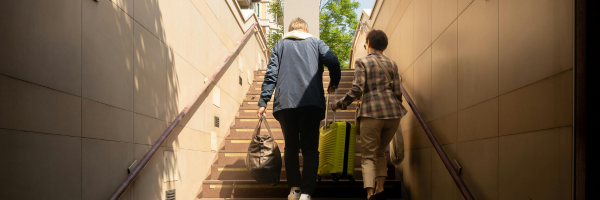
It looks like walking through Madrid for hours without anyone checking their watch. It looks like Porto’s hills being an inconvenience, not a barrier. It looks like taking the stairs without negotiation. And then it looks like heading to Morocco and hiking steep uneven trails in the Atlas Mountains outside Marrakesh – not as a bucket-list stunt, but as a continuation of how life has always been lived.
There is something deeply satisfying, almost defiant, about that. The expectation is that life narrows with age. That activity becomes optional, then difficult, then avoided.
And yet here we are, walking miles, climbing hills, exploring cities. Laughing when the wrong turn turns out to be the right one. Not surviving the day, but owning it.
Movement That Doesn’t Look Like Exercise
What stands out is how unremarkable it all seems. There are no scheduled workouts. No wearable devices buzzing with reminders. No metrics being tracked. It’s just movement. Walking to breakfast, to a museum, or just because the street looks interesting. Walking because it would feel strange not to.
And over the course of a day, those steps accumulate. Not as a number, but as a physiological effect. Blood sugar stabilizes. Circulation improves. Energy stays steady instead of spiking and crashing. The body feels used, in the way it was designed to be used. It’s exercise disguised as living.
Strength – The Quiet Insurance Policy
Even here, strength is present. Not in the form of barbells and mirrors, but in the ability to move through the world without hesitation. Lifting luggage. Carrying bags. Standing up from low chairs without using hands. Climbing stairs in a Moroccan hotel with no elevator. These are not dramatic acts. But they are decisive ones.
Muscle is the great protector of independence. It is what allows you to catch yourself when you stumble. To carry what you need. To keep going.
The 47-year study makes this clear. Strength and power decline with age, but not equally for everyone. Those who stay active lose less, and more importantly, they lose it more slowly. That difference is not academic. It is the difference between living independently and relying on others.
The Biology of Belonging
There’s another layer here that no graph fully captures – connection. Travel compresses it. You spend more time together, make more decisions together, and share more small moments that would otherwise be scattered across weeks at home.
Coffee in the morning. Navigating a menu in a language that almost makes sense. Laughing when something goes wrong and deciding it was right all along. These moments are not just pleasant, they are biologically active.
They lower stress hormones. They increase oxytocin. They stabilize the nervous system and they sharpen the mind. The brain does not drift or fade when it is engaged. The point is that social connection, not just while traveling, but in our everyday lives, is a critical part of healthy aging.
The Compounding Effect
This is where everything comes together. Movement improves mood. Mood encourages engagement. Engagement leads to more movement. Strength supports it all. It is a loop. A reinforcing cycle that builds resilience over time.
The study shows the opposite loop as well. Inactivity leads to decline. Decline leads to more inactivity. And over decades, the gap between these two trajectories becomes enormous.
By the time people reach their 60s, the difference is no longer subtle. It’s visible in how they move, how they think, and how they live.
Training for the Right Decade
Most people train for the wrong timeline. A race, a vacation, or a number on the scale. Biology is not interested in your short-term goals. It operates on a much longer horizon.
The real question is not how you perform at 40. It’s how you function at 75. Or 80 and beyond.
Can you walk for hours? Can you navigate uneven ground? Can you carry what you need and keep going. These are the metrics that matter. And they are being met here, not through bursts of effort, but through decades of consistent living.
The Quiet Rebellion
There is something quietly rebellious about all of this. The typical expectation is to decline with age. The assumption is a limitation. But that assumption only holds if you accept it.
What I’m watching is the alternative. Two people in their 80s walking through Europe, climbing hills, and heading into the mountains outside Marrakesh – not as an exception, but as a continuation. This is not luck. This is not genetics alone. This is the compounding effect of thousands of small decisions made over decades. To move, to stay engaged, and to lift when possible. To remain curious about the world.
The Takeaway
Aging is not a cliff, it is a slope. At first, it is gentle enough to ignore. Then it steepens. Then one day, it feels obvious and smacks us down.
But the slope is not fixed. You can influence it. You can slow it. You can change where it leads.
Stay connected, keep moving, and lift when you can. Do real things in the real world. Train for the version of yourself you want to be decades from now. Because that version is already taking shape. Right now, step by step, street by street, year by year.
Author
Scott Rollins, MD, is Board Certified with the American Board of Family Practice and the American Board of Anti-Aging and Regenerative Medicine. He specializes in bioidentical hormone replacement for men and women, thyroid and adrenal disorders, fibromyalgia and other complex medical conditions. He is founder and medical director of the Integrative Medicine Center of Western Colorado (www.imcwc.com) and Bellezza Laser Aesthetics (www.bellezzalaser.com). Call (970) 245-6911 for an appointment or more information.
